If you’ve read the first post in this series or are playing along yourself, you’ll be aware of the 52 Week Ham Radio Challenge. If not, hit up that link for the details!
This post covers the challenges from weeks 37-40, which were:
- Work 10 DXCCs on FT8
- Make a contact on Morse code!
- Make a 2-way contact with an output power of 100 mW or less.
- Which QSLing methods do you use, physical and electronic?
Week 37 (8-14 Sep): Work 10 DXCCs on FT8
A blast from the past—FT8 was my main mode as a newly qualified ham. Still nervous to pick up the microphone and talk to someone, I loved the quick no-nonsense exchanges, the gamified grid square map of GridTracker, and most importantly, how easily I could work the world on only the 10W I was allowed. It also impressed me from a purely technical standpoint (and still does); the decoder is doing an incredible amount of work to pull out such weak signals from the noise. I do kind of understand the hate it gets from some quarters, and it is a shame that there’s so little activity these days on most other digital modes. But as an easy way to get new hams excited about HF DX or QRP operation, it certainly has its place.
The goal for this week’s challenge was to make contacts in 10 DXCCs. I reached my 10 in relatively short order, but with only a few jobs to do around the house on the day of my attempt, I decided to come back to it throughout the day as propagation conditions changed. I worked my way up from 40m in the morning to 15m and briefly to 10, although the MUF didn’t quite rise high enough for more than a couple of QSOs on the band.
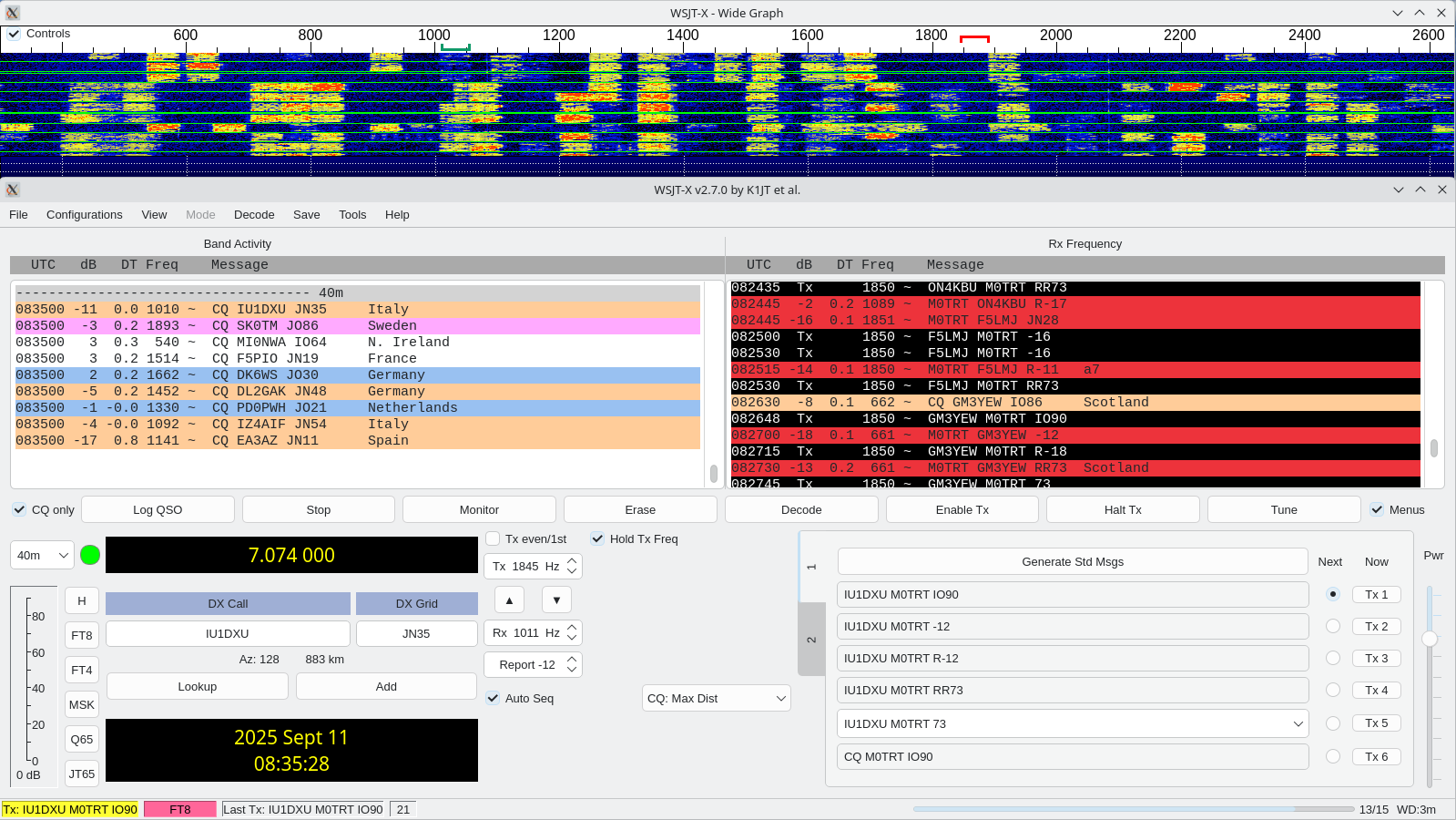
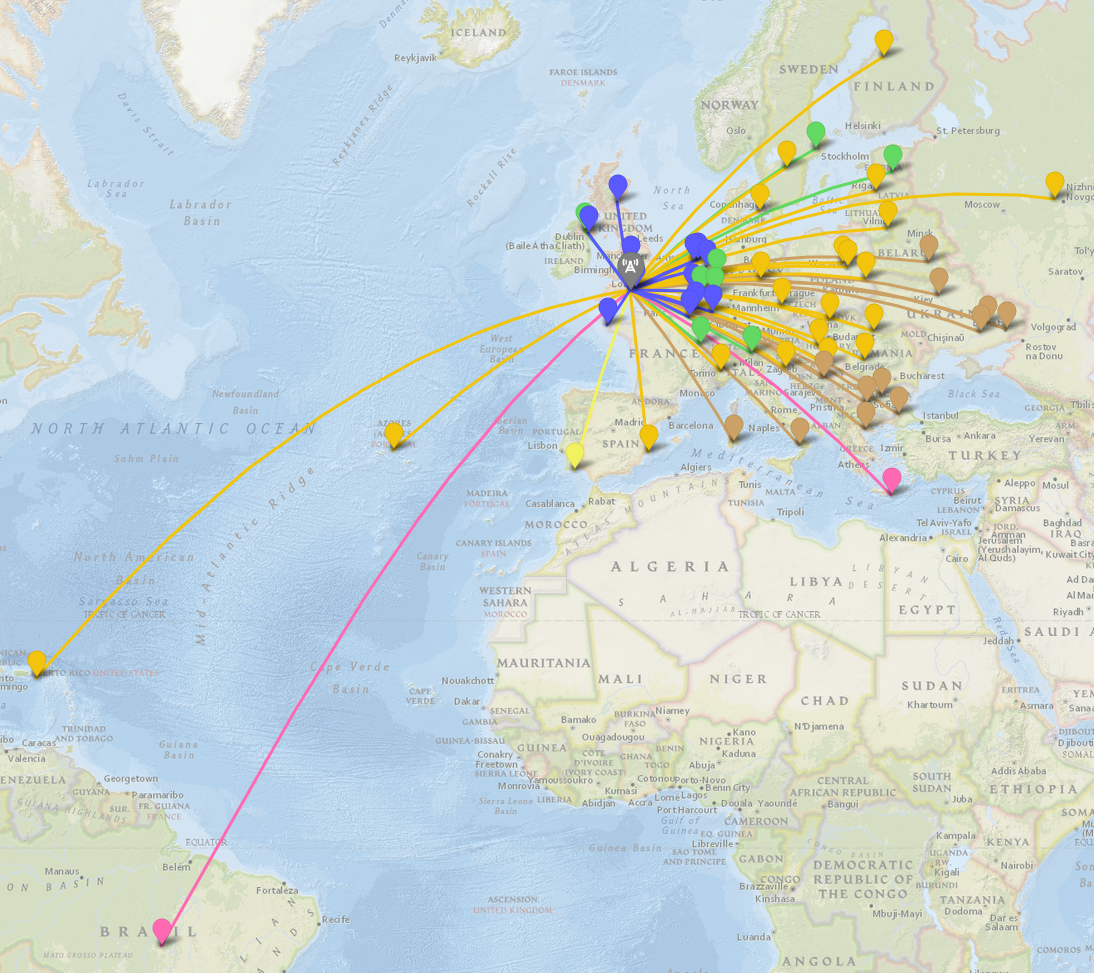
My total for the day was 35 DXCCs across 58 QSOs. For a while I was aiming for just one QSO per DXCC, but I put a bunch of CQ calls out on each band to see where my signal was reaching, plus I couldn’t help but work a few special event stations I spotted along the way. The highlights for me were a QSO with the St Croix Contest Group KP2B in the US Virgin Islands, a new DXCC entity for me, worked during a brief lift in 20m propagation to the Caribbean at around 0900-0930 UTC, and a the furthest DX at around 8300km with the Brazilian special event station PV203BR.
The list of DXCCs worked was as follows:
- Azores
- Belarus
- Belgium
- Bosnia-Herzegovina
- Brazil
- Bulgaria
- Crete
- Croatia
- Czechia
- Denmark
- England
- Estonia
- Finland
- France
- Germany
- Greece
- Hungary
- Italy
- Latvia
- Lithuania
- Netherlands
- Northern Ireland
- Poland
- Portugal
- Romania
- Russia (European)
- Sardinia
- Scotland
- Serbia
- Slovakia
- Spain
- Sweden
- Turkey (European)
- Ukraine
- US Virgin Islands
And the map of all my contacts:
Week 38 (15-21 Sep): Make a contact on Morse code!
Yeah, I know, I know. I really need to learn Morse. My brain is swimming in ideas for lightweight QRP SOTA/POTA kit, which all end up with me wanting to operate CW, and here I am still stuck making contacts with my voice like a newbie. In preparation for this challenge I tried to decode a 5wpm example, the slowest speed available, and failed even at that.
So, this one remains on hold. Maybe next year.
Week 39 (22-28 Sep): Make a 2-way contact with an output power of 100 mW or less.
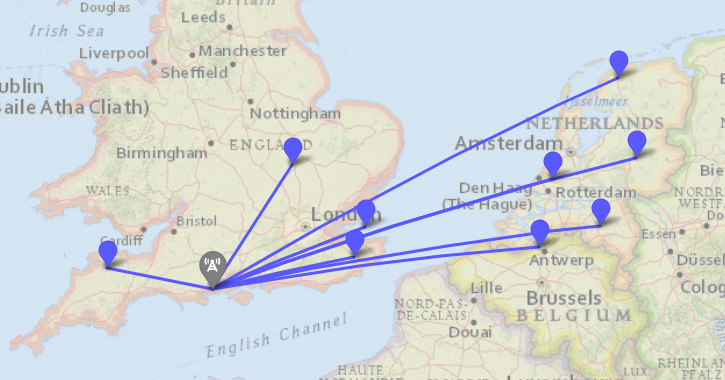
The only radio I have with an on-screen display of Tx power in Watts is the X6100, so I set it to 0.1W, and of course for the best chance of QRPp success I went for FT8 as the operating mode. Although week 28 saw me link the X6100 up to my computer as a receiver for the first time, I’d never transmitted through it this way before, so as expected there was a bit of a faff with audio levels and CAT ports.
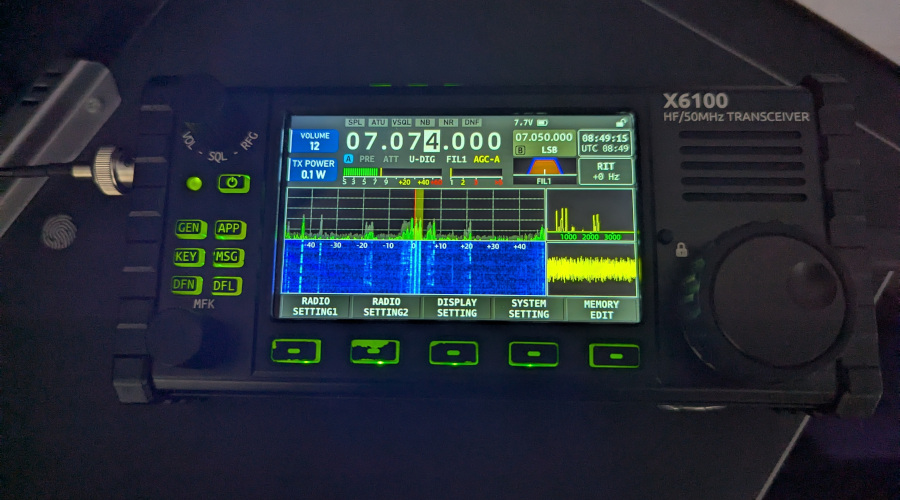
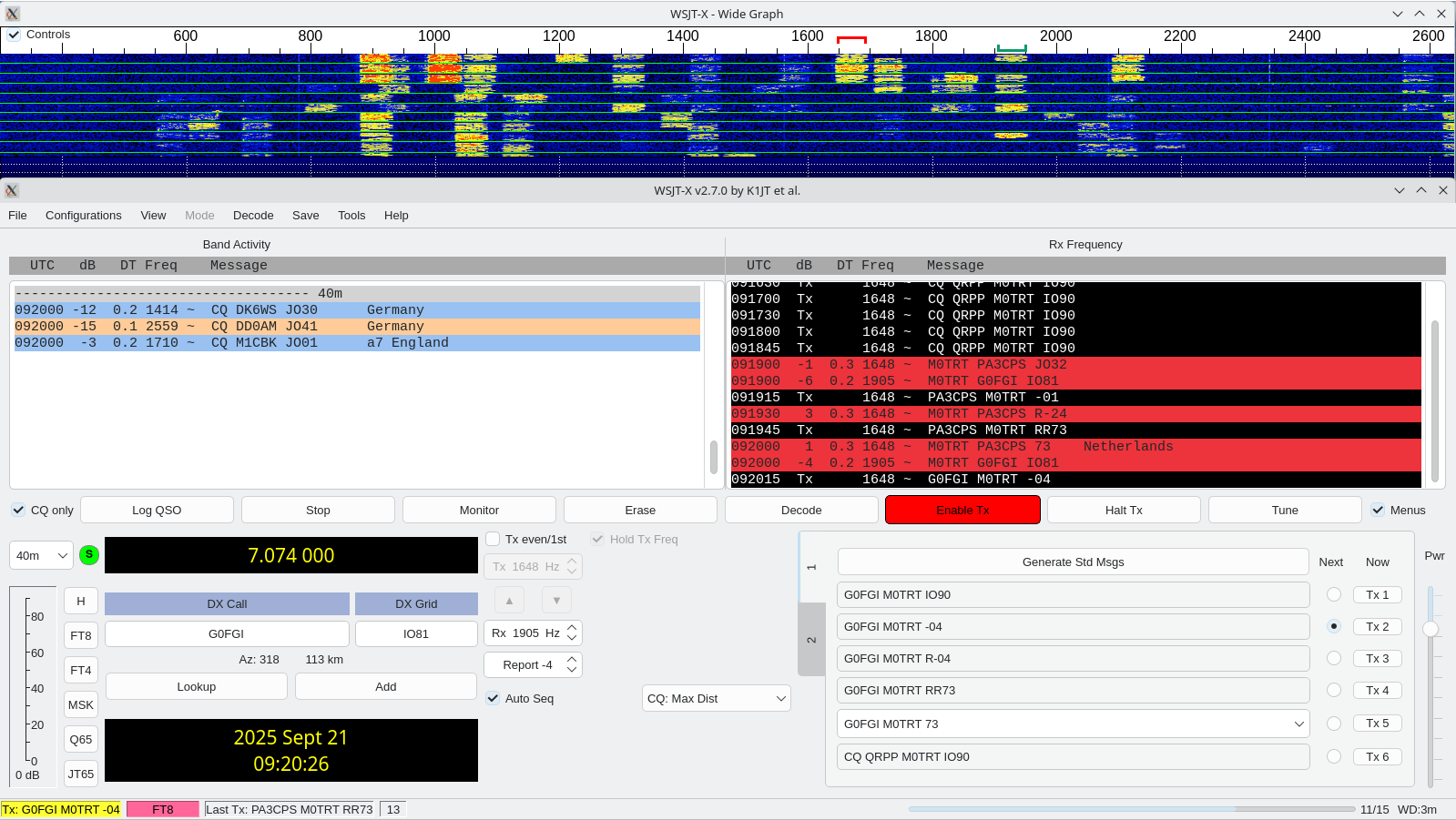
However, after only a couple of “CQ QRPP” calls the responses started to come in, and in half an hour of operating I made 9 QSOs with PA3CPS, G0FGI, PA3GHJ, M7ECR, OS4K, PA7D, 2E0KKH, G4HUE and PA2AF. All were on the 40m band using my home 13m EFRW antenna.
Week 40 (29 Sep - 5 Oct): Which QSLing methods do you use, physical and electronic?
A simple one this week, and the answer is: pretty much all of them!
My Wavelog server dutifully uploads details of all my contacts to LotW, QRZ, eQSL and Clublog. (Whether all of these are really considered QSL services, I have no idea—either way, all the details get uploaded and matched against other people’s.)
I also send physical cards, both direct and via the RSGB bureau. For the first few years of my amateur radio experience, I wasn’t bothered about physical cards, but I signed up for the bureau around October last year in case the Scout group wanted to do QSL cards for Jamboree on the Air. Then, Ham Challenge Week 1 got me designing my own card, and shortly after, I received by first ever set of cards via the Bureau. So then I had no choice but to get my own made!
My default, like most people, is not to send a physical card. But I’m always happy to send them on request via email or Clublog OQRS, and of course I will always send one back when I receive one unprompted.
I’ve also decided to request physical cards for particularly unusual contacts, if the other party offers them, e.g. unusual DXCC entities, very long range contacts, transatlantic park-to-parks, etc.
I still have around 200 cards left from my first batch, which will probably take years to get through—but of course I have already started designing the next one!
That’s all for this round-up, see you in early November for the results of weeks 41 to 44.
Comments