Today was the day of the RSGB LoRa Balloon Challenge, one of their activities for National Coding Week. The main part of the challenge was in advance; getting a 433MHz LoRa board set up to send APRS packets following these instructions. I appreciate the amount of effort that went into those instructions to help out those less familiar with cheap ESP32 LoRa boards, VS Code, and Platform.io. But since I had plenty of experience with all of those things, I blitzed through the setup in an hour or so last week, including wiring up my battery and case.
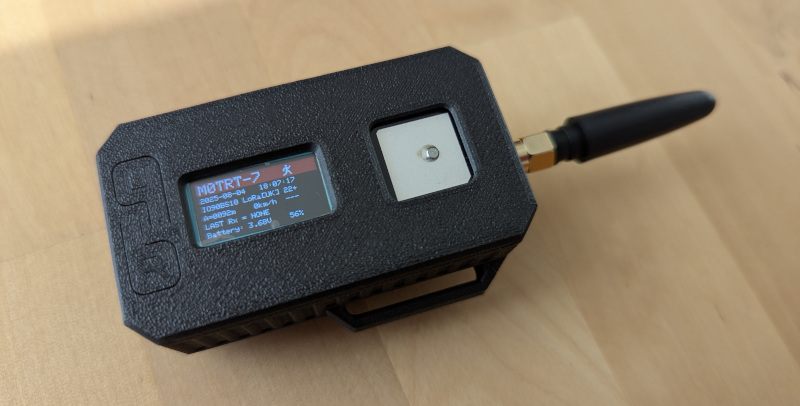
With the tracker now set up, there was nothing else to do until launch day but a bit of maths… and, it turned out, writing some code too.
The launch was scheduled for 1100 local time from Welshpool, a town just over 200km north-northwest of me. The expected flight time was around 2 hours, with a maximum altitude of 90,000ft or around 27,000m. Based on the distances involved, I estimated that it should appear over the nominal horizon once it reached an altitude of around 3500m, and assuming a constant rate of climb over the balloon’s flight path, this would be around 16 minutes after launch. There are various compounding factors that for simplicity I assumed would be negligible or cancel out, such as the forecast south-westerly wind moving the balloon further away, and the knife-edge effect potentially allowing my UHF signal to go beyond the visible horizon.
1116 local time was the target then, to be on a hilltop and waiting. I picked Hambledon Hill, conveniently to the north-west of home and also a place I’d never activated before, POTA GB-0590, WWFF GFF-0486, and HEMA G/HSC-007.
I would be heading to the hill with my Arrow antenna (with just the 70cm bits attached), as I had done for 433 Alive. But how should I best orient its beam to stand the best chance of reaching the balloon? For me, the answer was pretty much: north, and horizontal. Even at the balloon’s maximum altitude of 90,000ft, according to this calculator the maximum elevation angle I’d see would be around 6 degrees. I wasn’t planning to take an accurate level with me, so as far as I’m concerned, “roughly horizontal” would do. There would be no need to angle it upwards.
But what about people living closer?
Ah, bollocks. I’d been nerd-sniped.
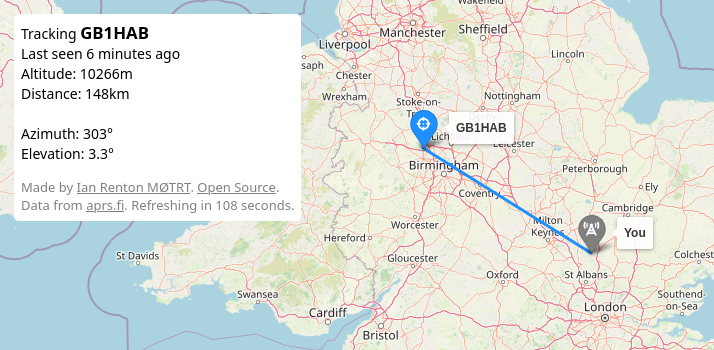
A couple of hours later, I emerged from the study having produced the APRS Azimuth/Elevation Calculator, a web app which will compare your device’s position to that of a target known to APRS.fi, and give you the azimuth and elevation to adjust your antenna to, as well as a real-time map.
Anyway, back to today, and back to the hill.
I can’t deny I was nervous about this one. Amongst a week of unseasonably nice weather, the forecast had the Saturday lunchtime spot very specifically targeted with heavy rain and rising wind. But tempting as it was, I couldn’t opt out of this one. I’d built the hardware, after all—I had to actually use it, otherwise it would just sit in the junk drawer forever, a reminder of failure.
Hambledon Hill is an Iron Age hill fort, one of many in the area, and a steep climb of about 1-in-4 in places. It towers imposingly over the landscape, and having climbed it, I can well imagine that my ancestors would have felt very safe from attack by other tribes atop a hill like this.
I sited myself at the north end of the hill, around a 1 kilometer hike from the lay-by where I’d parked, to get the best visibility northwards towards the balloon. By the time I got there it was closer to 1130 local time, so while the first thing to go up was the wind shelter, the 70cm Yagi antenna followed shortly after.
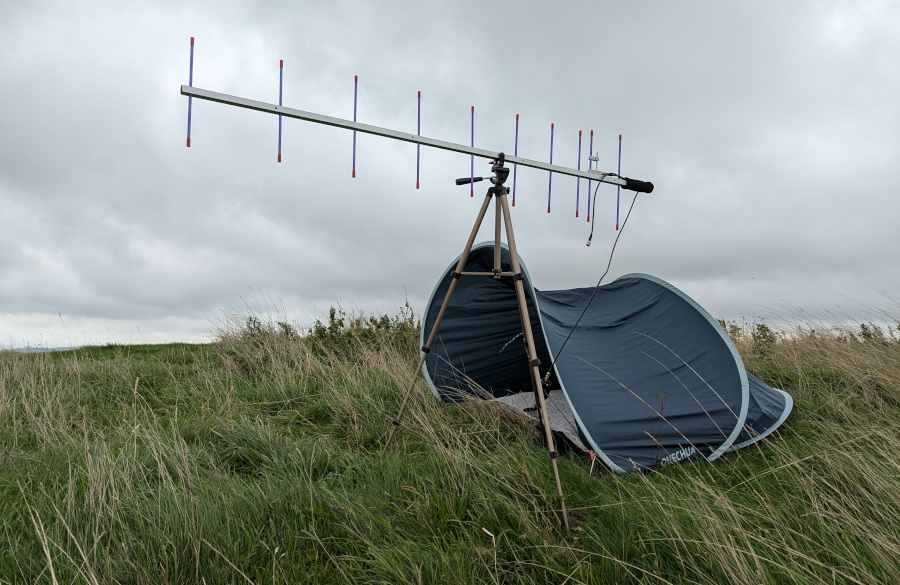
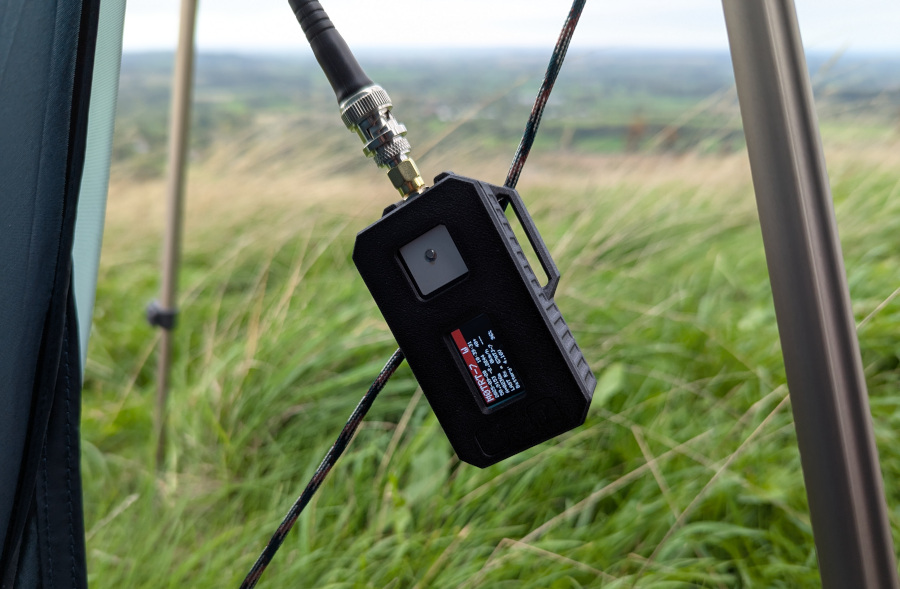
The wind was a bit high for a fully extended tripod, so I left it as you can see from the photo. From my position there were no obstructions to the north within 20 miles, and the balloon was already above my visible horizon, so I decided that would probably be good enough. I guyed the tripod with some paracord, stuck the wireless tracker on that, and settled in for a cup of tea.
The beaconing options on the wireless tracker APRS firmware didn’t seem to allow a fixed beacon rate anywhere faster than every 15 minutes, so I managed this manually—every so often, when I remembered, I leant over and pushed the left-hand button to trigger a manual transmission.
There isn’t a lot of flat land on the north side of the hill, so I was positioned very close to the path, and had quite a few interested walkers come and ask what I was up to. Oh, and about 50 Scouts on their way to a camp had chosen to hike the length of the hill as well!
The balloon tracker was happily pinging away, so besides chatting to walkers and Scout leaders, and drinking tea, there wasn’t much else to do. But of course, Hambledon Hill was a new POTA reference for me, so I’d packed some HF kit to pass the time.

I’d left the FT-891 and 20Ah battery in the car, as at 7kg they were just too much to haul up the hill with all my UHF equipment too. So I’d packed my X6100, along with the Sotabeams inverted-V dipole antenna, and set that up as best I could in the wind.
Unfortunately what I’d forgotten to do, was charge the radio.
On first startup it was already blinking a red battery indicator at me and reporting 7.2V, but it didn’t shut down immediately on transmit, so I thought I’d give it a go. I picked the 40m band to give my 5W the best chance of getting somewhere, called CQ, self-spotted, and let it run for as long as I could.
Unfortunately the number of QSOs I managed before the radio finally shut down on me was… Nine.
Huh.
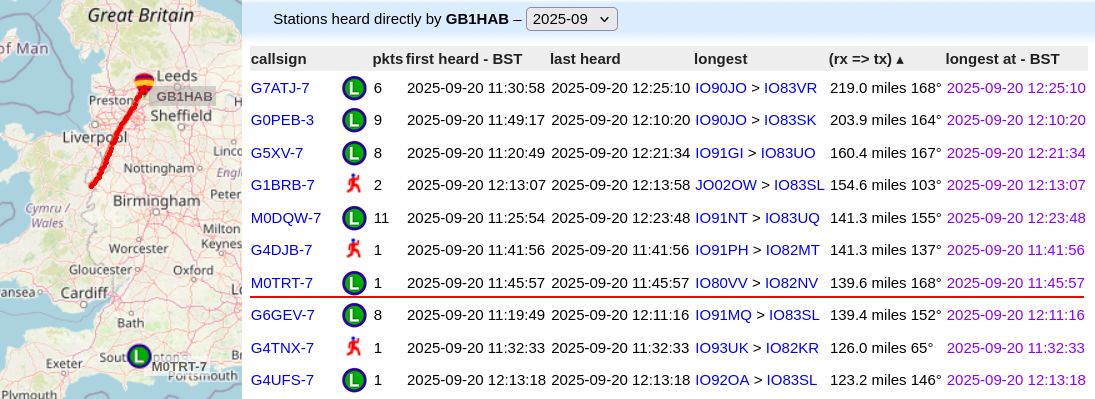
Well by that time, checking APRS.fi showed that the balloon had come down, so I wasn’t going to have any more chance to get my signal up to it. Checking the results showed I’d only got one packet to it, but one was enough! It was at a distance of 139.6 miles, putting me 7th in the competition. Not too bad for my first time trying this.
Now I just had my lunch to eat—and a POTA activation to complete. With everything packed down, I hiked all the way back to the car, ditched my UHF kit and the X6100, and picked up the QRO kit. The park boundary was only around 5 minutes from the car, and I didn’t fancy the climb up to the top of the hill again, so I set my antenna back up only a few hundred metres inside the park. This is one of the steeper sections, which made putting the dipole antenna up slightly awkward, but at least I got a nice photo with the hill fort defences in the distance.
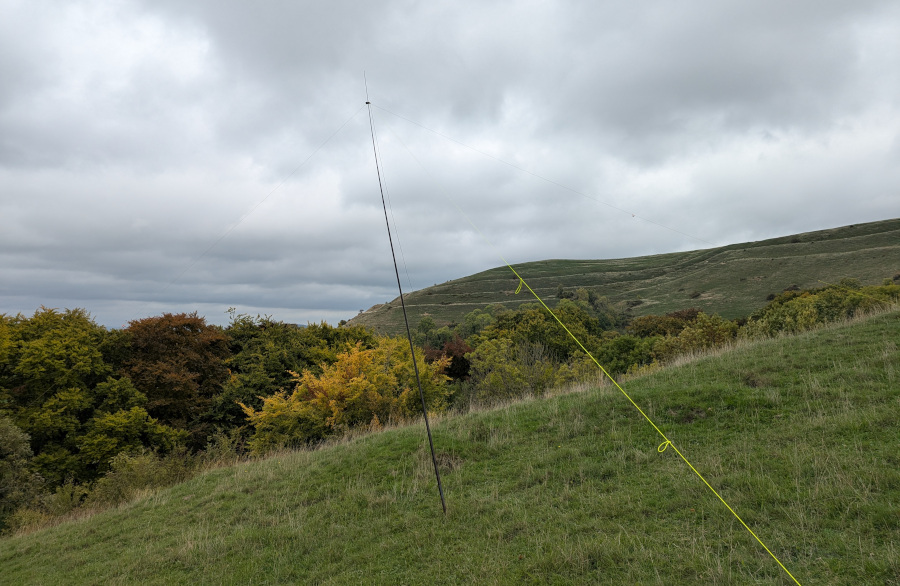
(I promise you the camera is level in this photo. I wasn’t kidding about it being a steep hill!)
PoLo’s Spots view showed me that Paul M0TZR was on a bunker activation, so with one quick park-to-bunker QSO, I had the 10 I needed for Hambledon Hill, and packed it all back down again.
Lessons learned for next time: Firstly, obviously, make sure my batteries are charged! And secondly, take an HT—I could have saved a half-hour of faff with one 2m FM QSO on the hilltop.
Well, it had been a great day out after all, and surprisingly a dry one. I’d been successful in the Balloon Challenge, activated a new park, got some badly-needed exercise, and enjoyed some fantastic views from the hilltop.
But you know what it hadn’t been?
A rove.
Just a couple of minutes’ drive from Hambledon Hill is GB-4481 Hod Hill, another Iron Age hill fort and another new POTA park for me. Of course I couldn’t resist swinging by to activate that too, even though as it turned out, I may not have picked the best coat for this one…

It was raining by that point, so the coat stayed on, and worse still, keeping my back to the weather also meant I was keeping my back to the majority of the site, where a bull could have taken a dislike to me at any time. There was a lot of looking over my shoulder during the activation, I can tell you!
Luckily I saw no sign of a bull during the half-hour I spent on site, and I got 20 contacts in the log. By the end, another conversation had sprung up on the same frequency, and the rain was getting heavier, so I decided to call it quits.
I’d got no more than a mile down the road before the forecast heavy rain finally arrived, pelting down in shimmering sheets across the fields, and confirming that as the end of my portable radio adventure for the day.
Besides, it’s Saturday, so my friends will soon be expecting a roast dinner and an apple crumble that I had better get on and make.
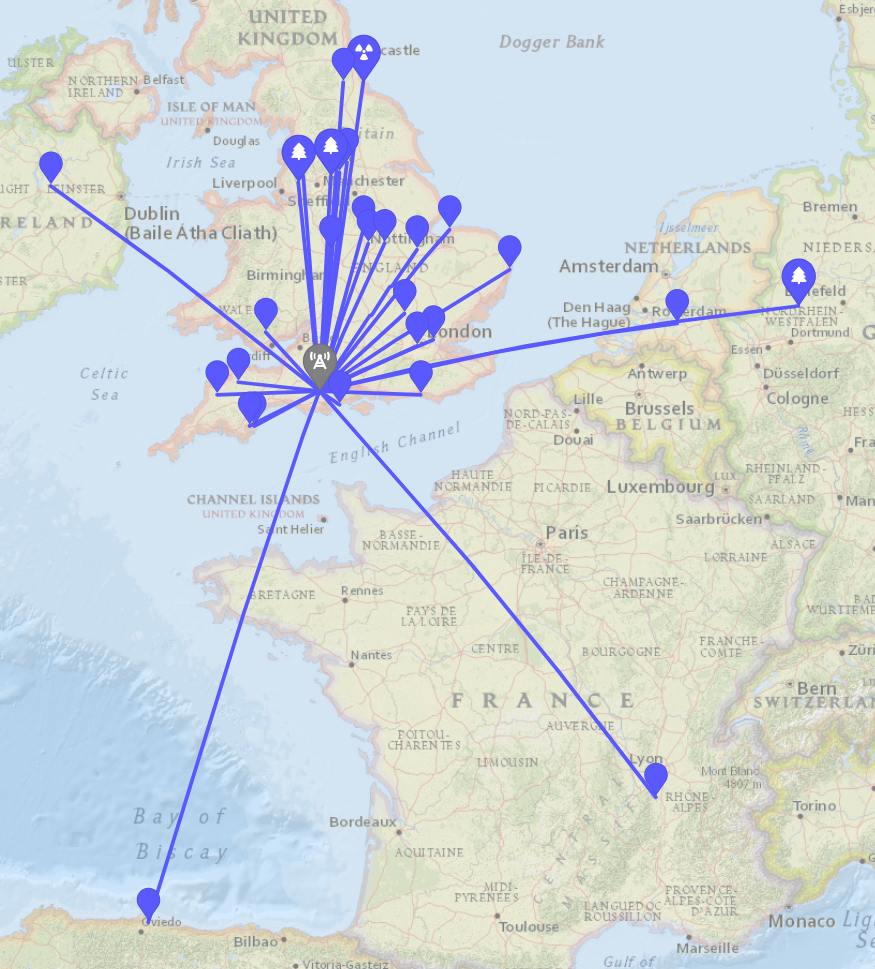
Thanks to all my POTA contacts today, and especially thanks to the RSGB for running the balloon competition. See you on the air next time!
Comments