Today’s journey back and forth along the coast gave my logging assistant and I one last chance for an activation over the Christmas break. This time it was the turn of G/SC-011 Hardown Hill, conveniently en route through the village of Morecambelake (home of the famous Dorset Knob (oh ah)).
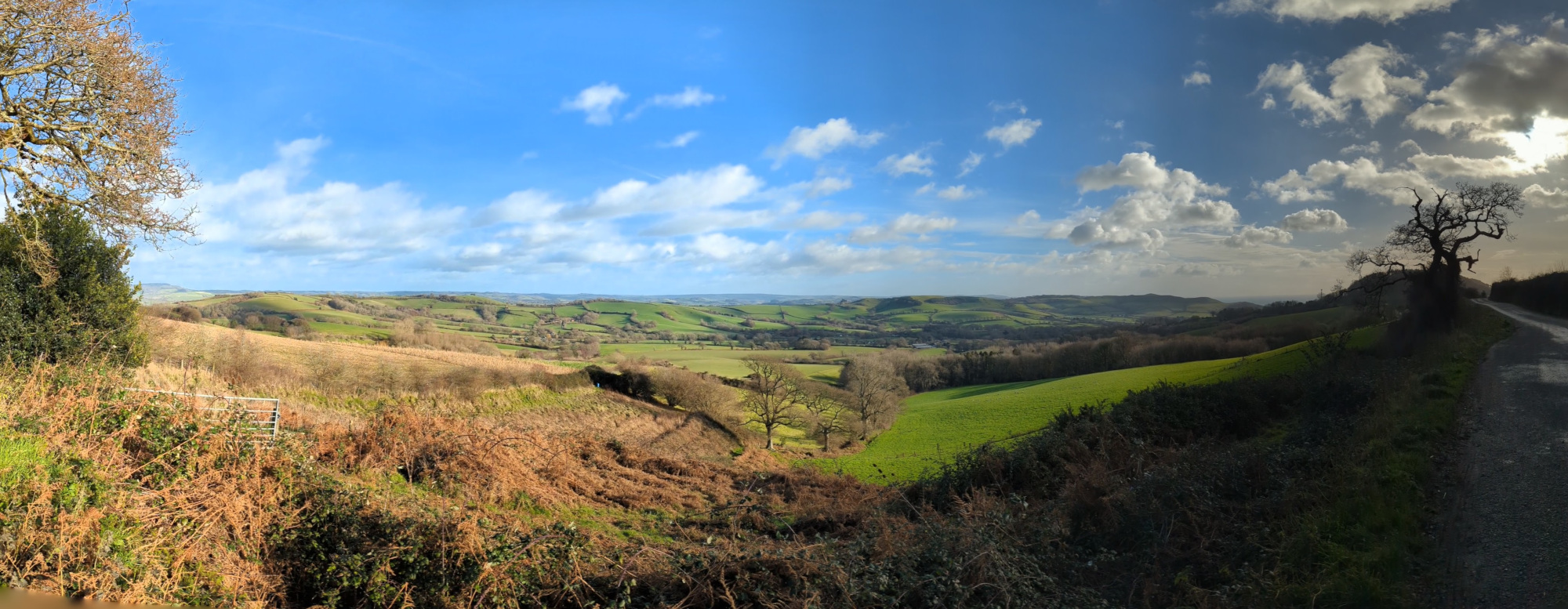
We followed the quick route to the top as suggested by M1HAX and G4TJC, parking initially in the lay-by at Ryall Road here to enjoy this impressive view.
From there, it was a 50m or so walk up the road until a gap in the hedge on the western side of the road with three ways to go: a gravel driveway on the left, a grassy route with tyre ruts up the middle, and a small dirt path on the right. Between the central and right-hand routes lies a sign reading “Private Land Keep Out,” but not clarifying which route it means.
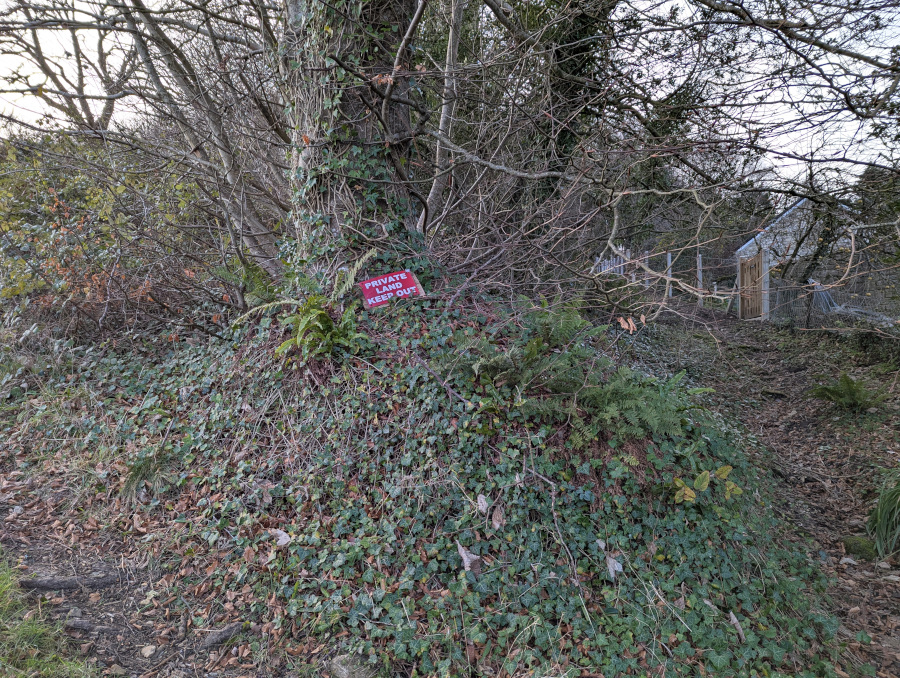
I can confirm that the middle path seems to be the private one, and the narrow path to the right that runs along a fence line is the route to the top of the hill.
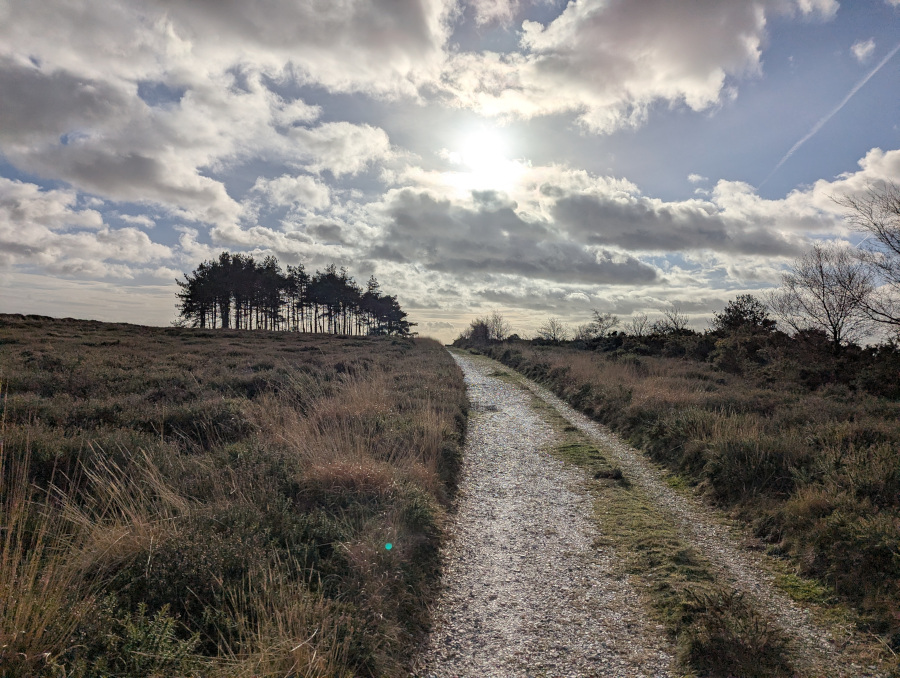
From here it’s an easy climb to the top, perhaps a 50m altitude gain over around 400m of walk. In the winter the path was easily followed, and remained relatively dry underfoot. In the summer I imagine it would be quite overgrown near the top.
After a short while the path opens out onto the top of the hill, and it’s only 50m or so until you find yourself on the “proper” path, which heads south to the copse of trees and the bench at the summit, and could be followed back south into Morecambelake if you prefer to take that route. From the summit you can see all the way to the sea, and Golden Cap on the coast.
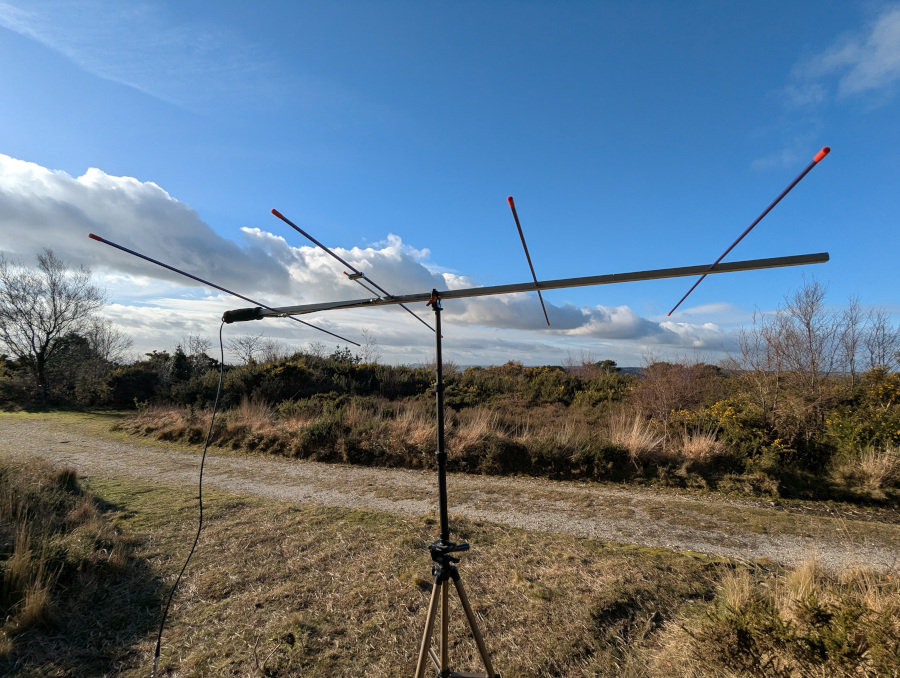
Our main goal of the day was to take part in the SOTA challenge for 2026 and get some 2m SSB contacts in the log. We’d brought the Arrow antenna, tripod and FT-817nd along to achieve this, and set up quickly next to the bench.
Unfortunately, we were immediately thwarted by equipment problems. The 817’s display showed no power output, and switching the meter to ALC mode showed no ALC action at all when speaking into the mic. I switched from SSB to FM, and keying the mic then transmitted the carrier just fine—I could see full power output and no SWR problems. But again there were no bars on the ALC meter, so I surmised I was just transmitting carrier with no modulation. A couple of just-in-case test calls on SSB and on FM went unanswered too. My diagnosis: something broken in the audio circuit, hopefully in the fist mic rather than in the radio!
Later on, back home, I opened up the fist mic and found one of the wires had come detached from the microphone. One quick solder job, and the microphone was returned to full working order. However, up on the hill, that ruled out any 2m SSB action today.
I hope my various frustrations with the FT-817 are all down to that fist mic and nothing else. I desperately want to love the 817, it’s such a neat radio, but today was its third time in the field and the third time I’ve had issues with it. (1, 2). I have still had only half a successful QSO on that radio.
However, as they say, “two is one and one is none”. My expectations for the 817 were low, and so we’d come prepared: we packed away the VHF kit, pulled out the X6100 and inverted-V dipole, and set that up instead.
There’s a lot of space on top of Hardown Hill, a vast expanse of furze and heather, but it’s not easy to wade through to set up a decent size antenna. Instead we made an odd choice, but it paid off: setting up in the copse.
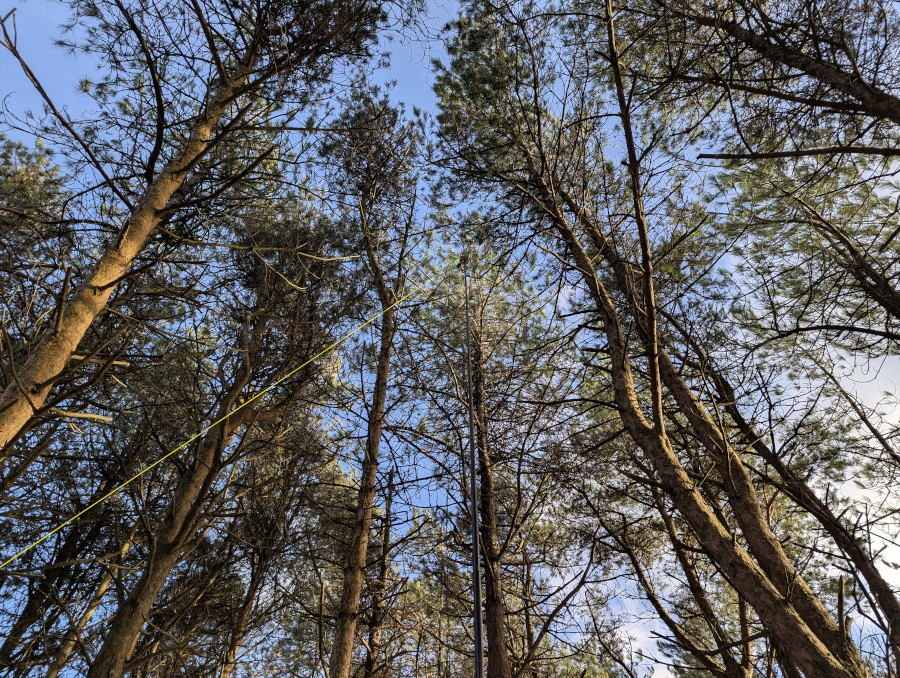
The pine trees provided a thousand potential snagging points for a wire antenna, but surprisingly we managed to set up and pack down the antenna without any issues.
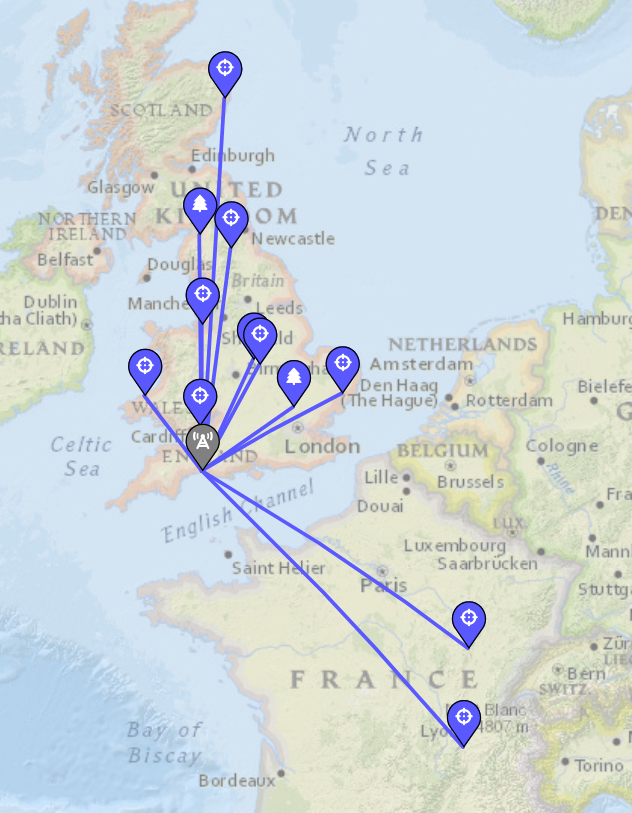
The X6100 is rapidly becoming my most reliable radio, despite being a “cheap” Chinese rig compared to the established Yaesus. We had 12 QSOs in half an hour on the 40m band, including a couple of stops to chat to interested dog walkers.
After completing the activation, we headed back down to the car via the same route.
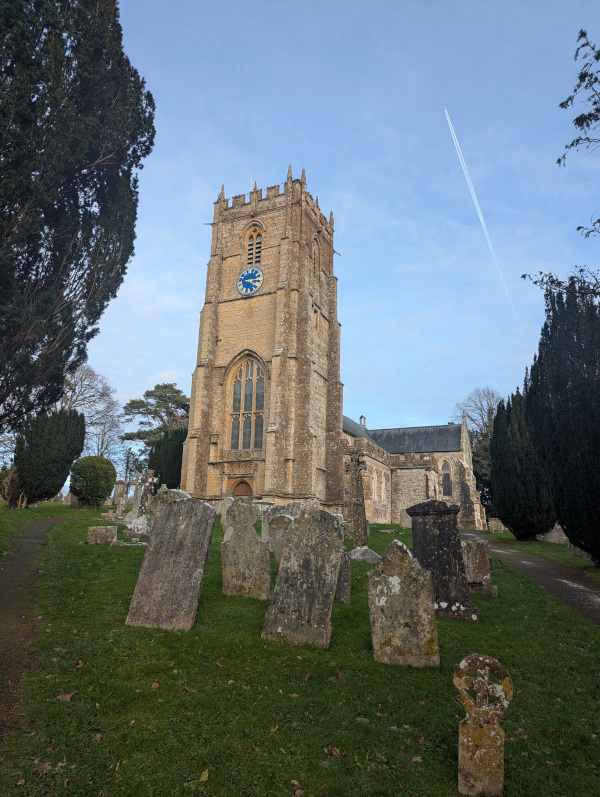
Our detour from the A35 continued by passing through Ryall and on to Whitchurch Canonicorum. The church here, of St Candida and the Holy Cross, is well worth a visit if you are passing. It is the burial place of St Wite (possibly the same person as St Candida or St Blanche), the patron saint of Dorset. Not only that, but the shrine reportedly still contains her bones, making them supposedly the only holy relics in England to have survived the Reformation.
The church is open most days and contains a wealth of information about itself and St Wite.
And that brings to an end today’s amateur radio and Dorset history tour. Many thanks to our contacts during today’s activation, and sorry to those hoping to work us on VHF. Fingers crossed for another summit with a working 2m SSB rig soon. See you on the air again next time!
Comments