I’m still working through the stack of QSL cards based on my first design, but already I’ve been thinking about ways to improve them. I’d like a front image which shows my antenna in front of some famous local scenery, rather than just the photo of Bournemouth beach I have now. And on the back, I’d like more information, more space for some things and less for others, and so on. So with those improvements in mind, I set about designing the next set.
My tool of choice for the first set had been LibreOffice Draw, but I encountered several issues this time around where I couldn’t properly align images and certain fonts appeared in distorted ways. I was heading for the sensible choice of Inkscape, but on the way I thought… what about LaTeX?
It’s not something I’d really used since university, and only then for relatively simple document layouts, but I had a quick search around the internet and found a couple of people who had done it and posted theirs online. One was none other than my fedi mutual Fabian DJ5CW, whose example is here.
I took Fabian’s code and extended it to produce a double-sided card, and changed the layout of the back to suit my preferences. Here’s the design I came up with:
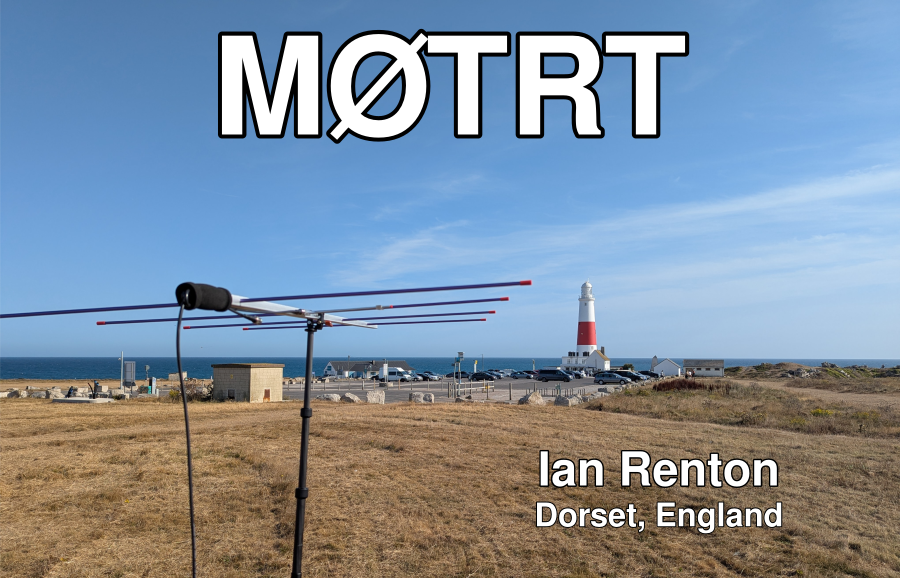
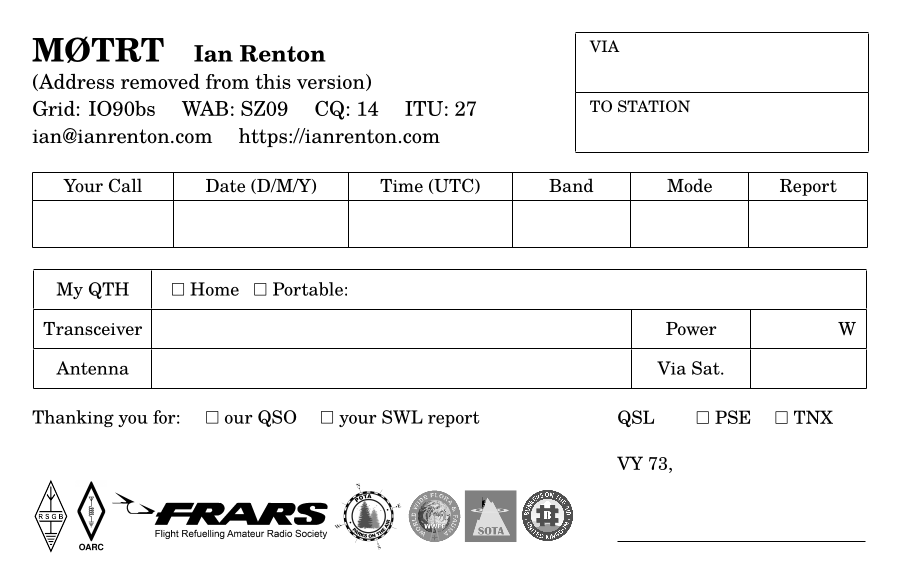
I’m quite happy with the reverse side now, but the photo on the front is still subject to change—if it’s going to be Portland Bill I could definitely take a photo from a better location, but one day I hope to work portable from probably Dorset’s most famous landmark, Durdle Door. A photo of that nicely framed by an antenna would make it to the QSL card for sure.
I’m by no means a wizard with LaTeX, so there’s probably quite a lot of things I could have done better, but in case you want to replicate what I’ve done the code is below. It uses a couple of plugins that are not in the basic texlive distribution on Debian, so if you’re looking to compile this for yourself you’ll need texlive-full.
% QSL Card design by Ian Renton M0TRT. Public domain. Based on an example by Fabian Kurz, DJ5CW.

\documentclass[10pt]{article}
\pagestyle{empty}
\usepackage{array}
\usepackage[T1]{fontenc}
\usepackage{tgschola}
\usepackage{amsmath}
\usepackage{amssymb}
\usepackage{latexsym}
\usepackage{graphicx}
\usepackage[export]{adjustbox}
\usepackage{eso-pic}
\usepackage{xcolor}
\usepackage{anyfontsize}
\usepackage[outline]{contour}
\usepackage[papersize={14cm,9cm}, margin=0.5cm, marginratio=1:1]{geometry}
\setlength{\parindent}{0pt}
\setlength{\parskip}{0pt}
\AddToShipoutPictureBG{
    \ifodd\value{page}
      \AtPageCenter{
        \includegraphics[width=\paperwidth,height=\paperheight,valign=M,center=-0.55em]{bg.jpg}%
        }
    \fi
}

\begin{document}
\vspace{0.5cm}
\begin{center}
\fontfamily{phv}\selectfont \fontsize{60}{72}\selectfont \textcolor{white}{\contour{black}{\textbf{MØTRT}}}
\end{center}
\vspace{4.5cm}
\hfill
\begin{minipage}{0.5\textwidth}
\begin{center}
{\huge {\fontfamily{phv}\selectfont \textcolor{white}{\contour{black}{\textbf{Ian Renton}}}}}

\vspace{6pt}
{\Large {\fontfamily{phv}\selectfont \textcolor{white}{\contour{black}{\textbf{Dorset, England}}}}}
\end{center}
\end{minipage}
\newpage
\begin{minipage}{0.6\textwidth}
{\Large \textbf{MØTRT}} \quad {\textbf{Ian Renton}}

{\small (Address removed from this version)}

{\small Grid: IO90bs \quad WAB: SZ09 \quad CQ: 14 \quad ITU: 27}

{\small ian@ianrenton.com \quad https://ianrenton.com}

\end{minipage}
\hfill
\begin{minipage}{0.35\textwidth}
\begin{tabular}{ | m{11.7em} | }
\hline
{\scriptsize TO STATION \vphantom{$\int\limits_{\dfrac aa}$}}\\
\hline
{\scriptsize VIA \vphantom{$\int\limits_{\dfrac aa}$}}\\
\hline
\end{tabular}
\end{minipage}

\smallskip

\begin{center}
\begin{tabular}{|w{c}{5em}|w{c}{6.5em}|w{c}{6em}|w{c}{4em}|w{c}{4em}|w{c}{4em}|}
\hline
{\footnotesize Your Call}&{\footnotesize Date (D/M/Y)}&{\footnotesize Time (UTC)}&{\footnotesize Band}&{\footnotesize Mode}&{\footnotesize Report}\\
\hline
\vphantom{$\dfrac b b$}& & & & & \\
\hline
\end{tabular}

\bigskip

\begin{tabular}{|w{c}{4em}|w{c}{20em}|w{c}{4em}|w{c}{3.9em}|}
\hline
{\footnotesize My QTH} & \multicolumn{3}{l|}{\footnotesize \vphantom{$\dfrac b b$} $\square$ Home \enspace $\square$ Portable: } \\
\hline
{\footnotesize Transceiver} & {\footnotesize \vphantom{$\dfrac b b$} } & {\footnotesize Power} & {\footnotesize \vphantom{$\dfrac b b$} \qquad \qquad W} \\
\hline
{\footnotesize Antenna} & {\footnotesize \vphantom{$\dfrac b b$} } & {\footnotesize Via Sat.} & {\footnotesize \vphantom{$\dfrac b b$} } \\
\hline
\end{tabular}
\end{center}
\vspace{3pt}
\begin{minipage}{0.65\textwidth}
{\footnotesize Thanking you for: \quad $\square$ our QSO \quad $\square$ your SWL report}
\end{minipage}
\hfill
\begin{minipage}{0.3\textwidth}
{\footnotesize QSL \quad \quad $\square$ PSE \quad $\square$ TNX}
\end{minipage}

\begin{minipage}{0.65\textwidth}
\vspace{2em}
\includegraphics[width=0.07\textwidth,valign=m]{rsgb.png}
\includegraphics[width=0.06\textwidth,valign=m]{oarc.png}
\includegraphics[width=0.4\textwidth,valign=m]{frars.png}
\includegraphics[width=0.13\textwidth,valign=m]{pota.png}
\includegraphics[width=0.095\textwidth,valign=m]{wwff.png}
\includegraphics[width=0.095\textwidth,valign=m]{sota.png}
\includegraphics[width=0.1\textwidth,valign=m]{ukbota.png}
\end{minipage}
\hfill
\begin{minipage}{0.3\textwidth}
\vspace{0.5em}
{\footnotesize VY 73,}

\vspace{1.5em}
\makebox{\rule[-0.5em]{11em}{0.4pt}}
\end{minipage}

\end{document}
The full source, including the image files I used, is here, and if you’d like to see the PDF output, that’s here.
Happy typesetting and 73!
Comments