My part of the world is home to two major rivers, the Stour and the Avon, which both meet each other and the sea at Christchurch. Both have trails along their length that have been recently added to the POTA system, as has the Castleman Trailway, which crosses them both. And so, I decided a nice idea for a quick POTA rove would be to activate these meeting spots one after another.
0900-0930Z: Avon Valley Path / Castleman Trailway
Both GB-6372 Avon Valley Path & GB-6370 Castleman Trailway are extensive trails that could be activated just about anywhere along them. The Castleman Trailway is part of what remains of the old Dorchester-to-Southampton railway, running from Upton House in the west, into the New Forest in the east. The Avon Valley Trail is even longer, running from Salisbury in the north to Mudeford in the south, including a number of villages on the way (a liberal reading of the POTA rules may allow you to activate it from the beer garden of the Woolpack Inn).
The POTA requirement for “trail” type parks is that your entire station must be within 30 metres of the trail, which can make things difficult by itself. But if I wanted to activate them both at their sole meeting spot, I would have an area of just 30x30m square in which to set up. And keeping the public out of RADHAZ range means any radiating element being around 6 metres away at minimum, reducing that area in effect to 24x24m.
These two paths intersect here, at this fairly uninspiring spot outside Ringwood:
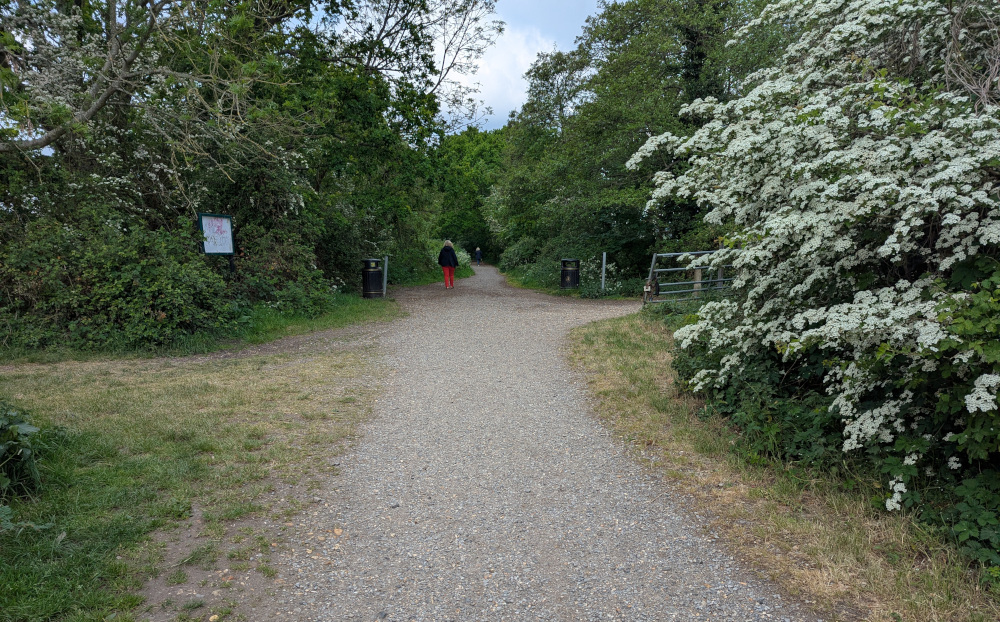
This area is busy with walkers, and setting up directly next to the trail was a non-starter. I was planning on going for the open grassland to the south of the Castleman Trailway, which the Avon Valley Path cuts through, but on arrival it did not look much like common land—instead, there were grazing cattle and horses, and it looked very much like a public right of way through private farmland. As always, “right of way” means to walk, sometimes to cycle, very rarely to set up an amateur radio station!
Happily, just north of the intersection, there is a small gravel area next to the river, with just enough space for the JPC-12 vertical, though not for any large dipole antennas.
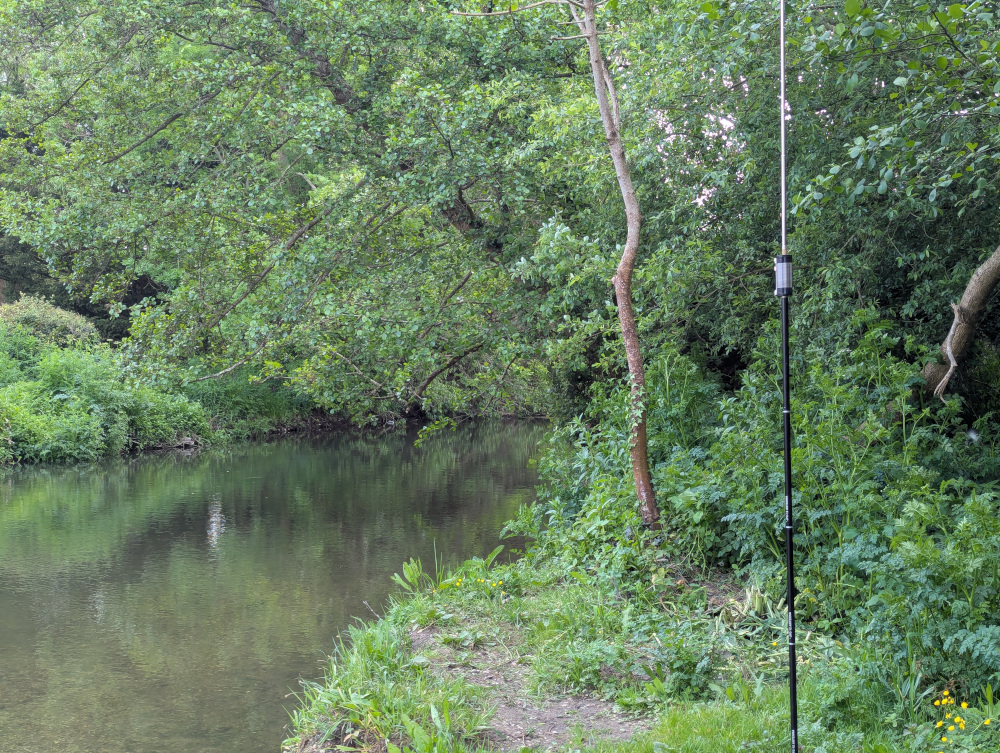
I set up here, and although the bands weren’t in great shape, I made 11 contacts in around half an hour, including John G4POF from the local club via ground-wave. All contacts were made using 100W on the 20m band using the Yaesu FT-891.
It’s about nine miles from this spot to the point the Stour Valley Way crosses the Castleman Trailway, so in the interests of time, I drove around to my second spot today. It would make a nice, if unexciting, cycle; probably too far for a walk if you had to walk back to the other end again too!
1030-1130Z: Stour Valley Way / Castleman Trailway
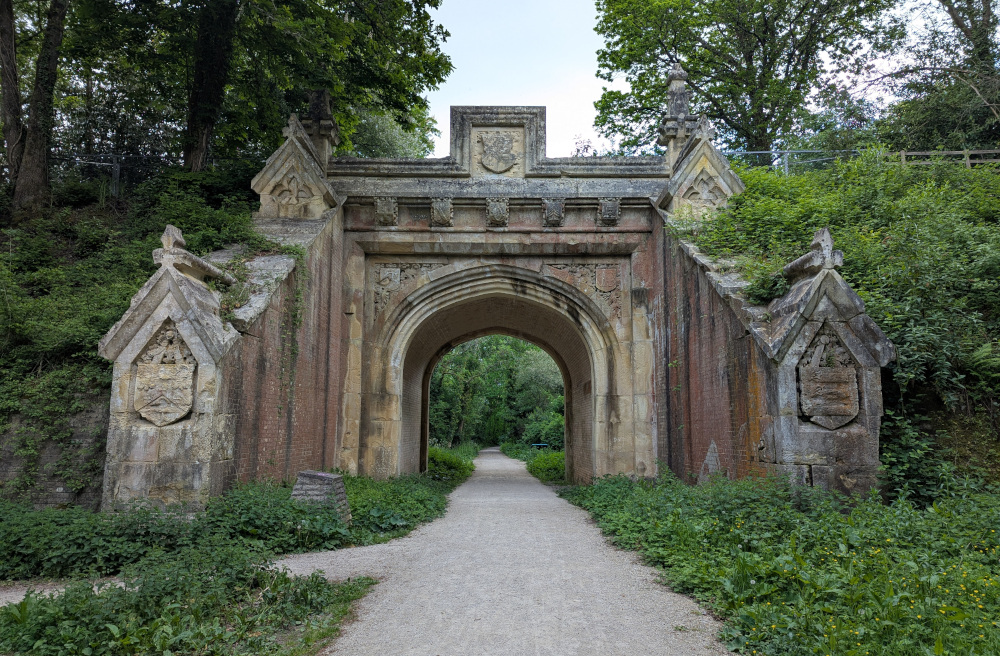
Compared to the uninspiring meeting of the Castleman Trailway with the Avon Valley Path, its meeting with the Stour Valley Way is this impressive structure: Lady Wimborne’s Bridge.
GB-6830 Stour Valley Way has been on the POTA system since yesterday, and yet somehow I am the fourth activator. I share the leaderboard with exactly who I thought I’d be sharing it with: Ingy M0MHJ, John M6EAM and Roger G5RWM.
The Stour Valley Way in its entirety is the longest trek of them all, starting with the Stour at Mere in Wiltshire, passing through many other POTA parks and scenic spots, and winding its way down to the sea at Christchurch. By my reckoning I would have activated it seven times already if it were in the POTA system since the start!
There’s some space at the bottom of the bridge for an antenna, but this was thickly carpeted with nettles, and in any case I didn’t want a giant wall of stone between me and my contacts, so I headed to the top. With a narrow path and thick woods either side on the Castleman Trailway (top) side, the only real open space here is directly on top of the bridge, so… that would have to do.
Then, the comedy of errors began.
I hadn’t brought my tripod with me, so all I had available to keep the antenna upright was the ground spike—not too effective on top of a stone bridge, although plants were encroaching on it so there were a few centimetres of soil in places. After a few attempts to get the ground spike in, I gave up, and decided the antenna would have to be propped up against something. Then, having put the rest of the antenna together, it occurred to me: where was the whip?
Unknown to me until the end of the activation, the ground spike I’d been trying to shove into any available soil… was the whip. How I didn’t spot that I have no idea. As to where the ground spike went to, I’m not sure—I retraced my steps in case it fell out of my bag but couldn’t find it, so perhaps I accidentally left it at my first spot. I will need to revisit at some point to find out.
So, I sort-of had a ground spike (the whip that I had now broken beyond recovery by stabbing it into the ground), but no main radiating element. The activation attempt was over before it had even begun.
…
But I did have three ground radials. Probably didn’t need three, right?
Time to Heath Robinson an antenna. (Substitute “MacGuyver” as necessary depending on your age and nationality.)
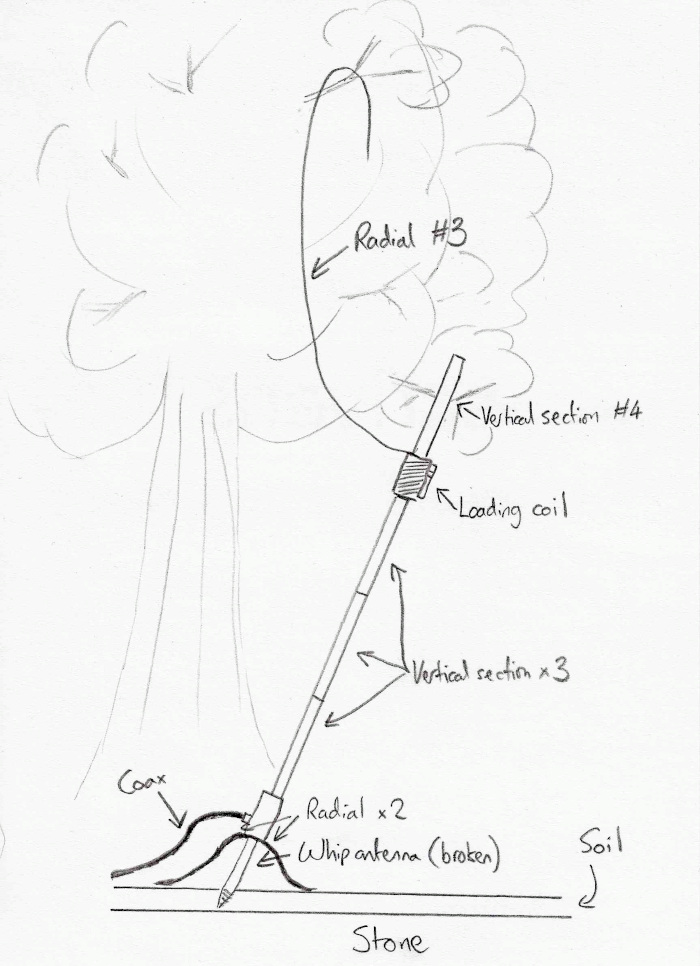
While the JPC-12 is very flexible and allows a variety of ways to combine its sections, I bet today was the first time this one has been tried.
Vertical section #4 was doing double duty here, both allowing the antenna to rest on a convenient bramble, and clamping the radiating wire down into the top of the coil. With zero turns on the coil (slider at the top) I managed a 2:1 SWR, and with some rearranging of how the wire was hanging in the tree, I eventually managed pretty well a spot-on 1:1 SWR.
As we all know though, SWR isn’t everything (a 50 Ohm dummy load has perfect SWR after all), and this setup was… trash. Poor band conditions didn’t help today, but oh boy was it hard work making contacts.
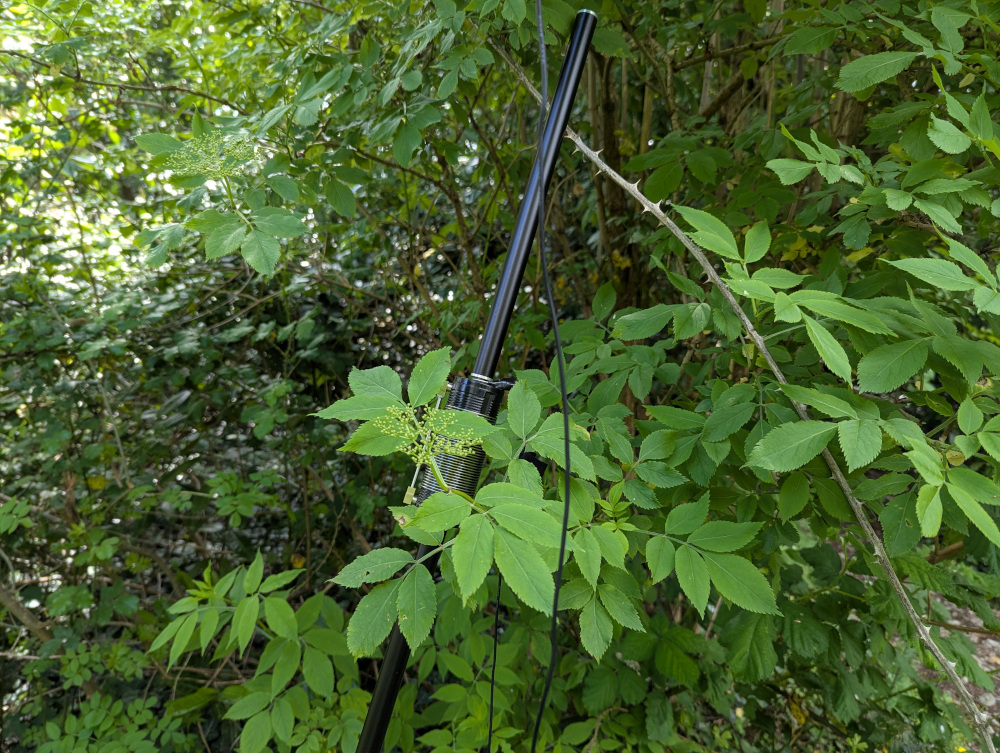
It took over ten minutes to get my first contact. Hilariously at that point, the main body of my antenna fell down, and I immediately received a call from K2UPD in which he gave me a 54 report. Did this antenna genuinely work better with the main bit on the floor?!
You’ve heard of “inverted L” antennas, now try “actual L” antennas, just leave the radiator running along the ground, probably fine??
I spent the rest of the activation playing with the antenna and the layout of my two remaining ground radials, hoping for some improvement in performance, but contacts were slow coming and I rarely received or gave a report above S5. My transatlantic fluke was not repeated, but in the end a variety of hunters around Europe got me over the line after an hour on the air.
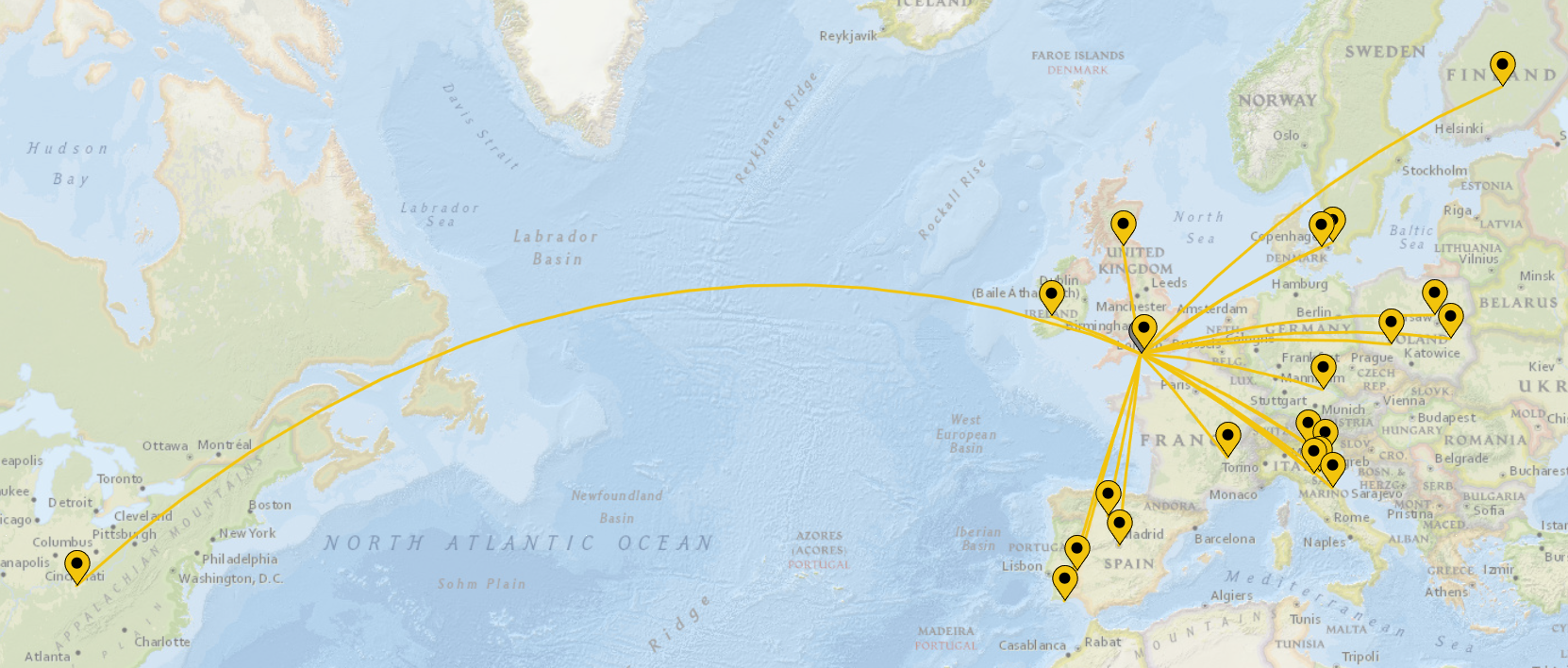
Thanks to all my contacts today, especially those that struggled to make it work at the second activation spot. I’m off to order a new whip for this thing, catch you on the air next time!
Comments